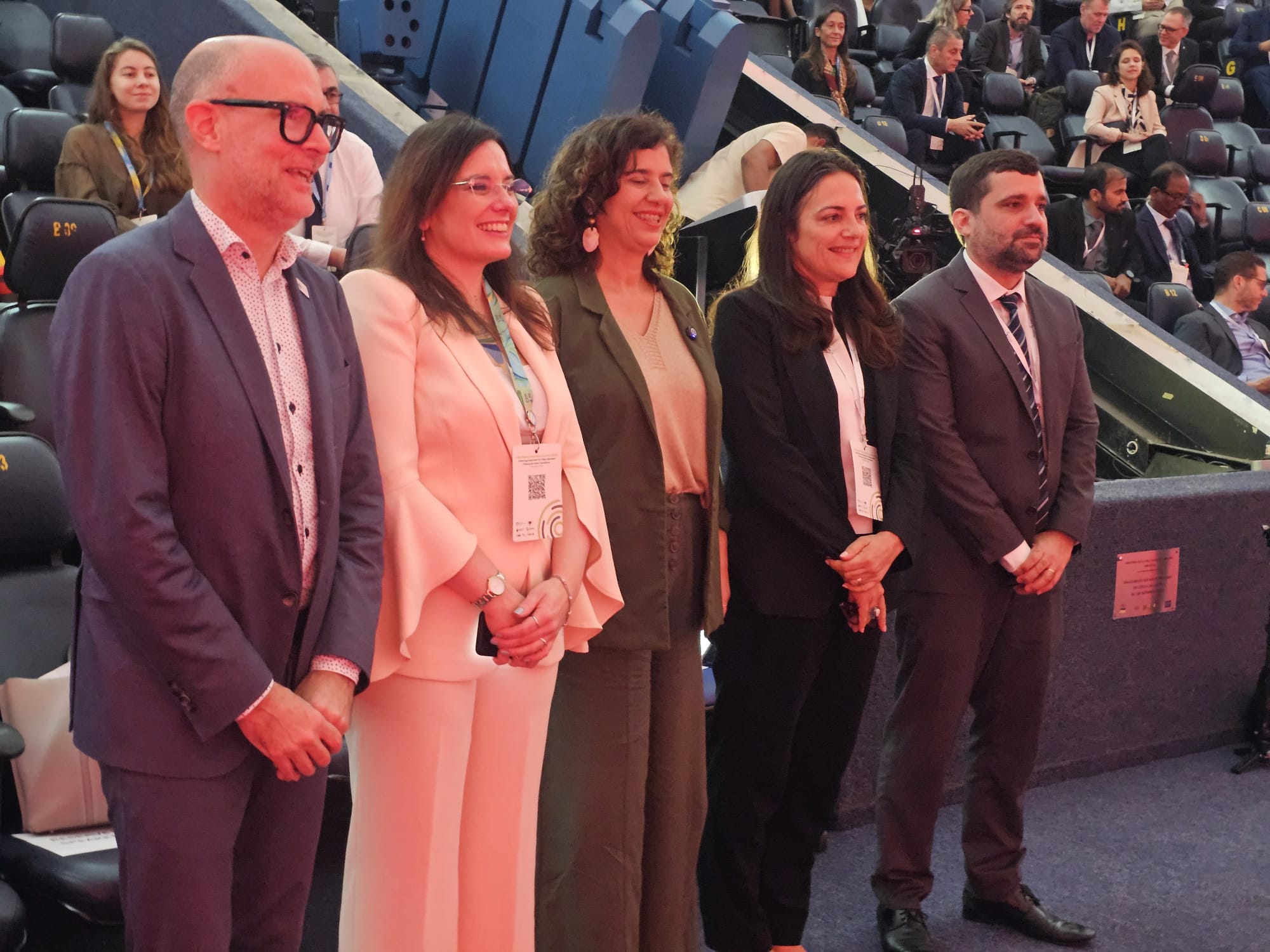
The Energy Research Office (EPE) participated on November 6, 2025, in the Urban Transitions Mission Global Innovation Summit, held at the Planetário da Gávea in Rio de Janeiro. As a member of the Urban Transitions Mission (UTM) and co-organizer of the event, EPE reaffirmed its commitment to international cooperation and to developing planning instruments that support cities in advancing toward more sustainable, resilient, and inclusive urban models.
The opening panel brought together Tatiana Roque, Municipal Secretary of Science and Technology of Rio de Janeiro; Stéphanie Horel, Programme Officer for the Americas at the Delegation of the European Union to Brazil; and was moderated by Andy Deacon, Co-Managing Director of the Global Covenant of Mayors for Climate & Energy (GCoM). Representing EPE, Gustavo Naciff de Andrade highlighted that energy consumption in Brazil is highly concentrated in urban areas, emphasizing that “the energy transition is, above all, an urban transition.” He noted that while Brazil benefits from a predominantly renewable energy matrix, the country faces challenges associated with climate change that require new solutions.
Gustavo presented recent EPE initiatives that strengthen the country’s planning capacity — among them, the work developed with the EUROCLIMA+ Programme, which provides guidance for the sustainable use of energy infrastructure in cities, including digitalization, smart management, and innovative solutions for local governments. He also referenced EPE’s study on the impacts of climate change on Brazil’s future power system, which demonstrates how climate analysis and advanced modeling can reduce operating costs and enhance system resilience.
The EPE representative stressed that planning is also essential for ensuring the bankability of projects. In this regard, he highlighted Brazil’s experience with transmission auctions, an international reference for how public planning, combined with clear regulatory mechanisms, can mobilize billions in private investment and translate strategic directives into real infrastructure.
According to Gustavo, this alignment between strategic vision, regulatory clarity, and the ability to attract private capital is precisely the foundation of the Global Coalition for Energy Planning, launched under Brazil’s G20 presidency. As he stated:“Good planning reduces risk and increases bankability. It connects public ambition with private confidence.”
He concluded by noting that this logic — which integrates energy planning, public policy, and financial instruments — is at the core of the discussions at the Summit. For EPE, expanding the use of blended finance will be essential to unlocking investment and supporting Brazilian cities in building a more inclusive, resilient, and low-carbon future.